
 ·
5 minute read
·
5 minute read
In the early stages of building operational systems, the ability to rapidly connect software applications feels like a superpower. That superpower has a shelf life, though, what holds up under enterprise load looks nothing like what got you off the ground.
The emergence of visual, low-code middleware platforms allows business teams to instantly link an Airtable database to external CRMs, marketing tools, Slack channels, and billing engines without writing code.
By utilizing simple, trigger-action configurations, operators can bypass IT development queues and automate basic data transfers in minutes.
However, as an organization scales its digital footprint, this organic approach to integration becomes a severe operational liability. When teams continuously append ad-hoc, point-to-point connections to solve immediate workflow needs, they create a fragile, undocumented web of dependencies—what systems architects call Integration Glue.
The visual simplicity of low-code middleware masks deep architectural flaws: without strict schemas, validation gates, or transactional safety, these ad-hoc pipelines inevitably fail under enterprise volumes.
For database architects and systems operations leaders, maintaining this point-to-point network becomes a high-risk chore. To protect operational continuity, organizations must transition from fragile visual middleware webs to a secure, centralized Enterprise Service Bus (ESB) architecture.
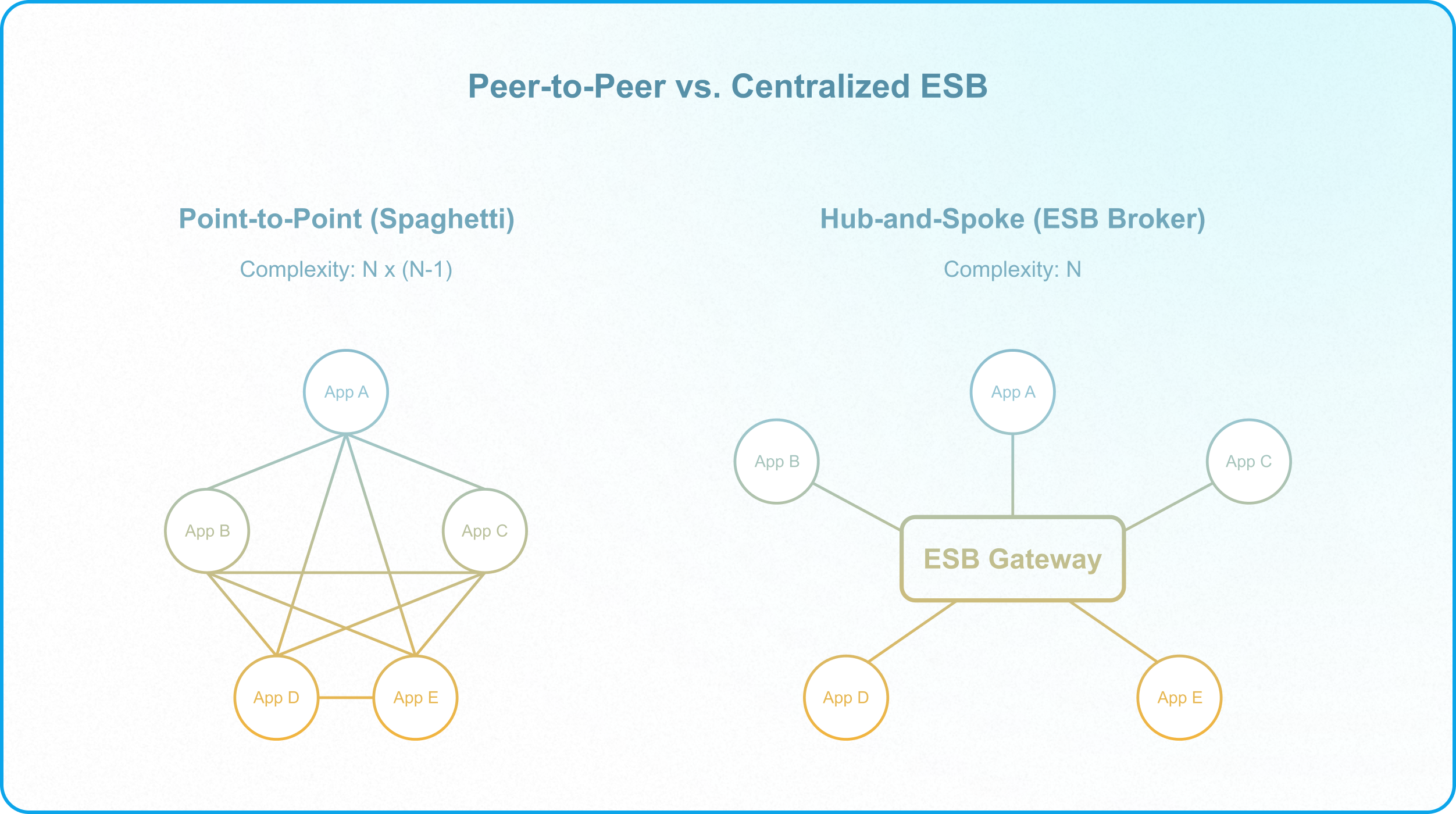
1. The Point-to-Point Topology: Anatomy of a Silent Failure Chain
The core structural flaw of integration glue lies in its topology. In a point-to-point integration network, every application is connected directly to every other application it needs to share data with.
The $N \times (N-1)$ Complexity Problem
As the number of software applications ($N$) in an enterprise increases, the number of individual connections required to keep them aligned grows quadratically according to the formula:
[C = N \times (N - 1)]
If an operations team manages 5 core platforms (e.g., Airtable CRM, Salesforce, Slack, Gmail, and Quickbooks), they must build and maintain up to 20 individual connections. If they expand their stack to 10 platforms, that number climbs to 90.
At this level of complexity, the integration network is no longer maintainable. It degrades into an unmappable web of data flows, closely mirroring the structural debt analyzed in Spaghetti Architecture.
Silent Cascading Failures
Because ad-hoc low-code connector pipelines lack centralized schema governance, they are highly sensitive to upstream changes.
If a creator renames a field in Airtable or alters a single-select option (e.g., from In Progress to Processing), the platform permits the change on the fly without throwing a system error. This is the snapshot fallacy and schema drift problem detailed in The Illusion of Maintainability in No-Code.
However, downstream in the point-to-point network, the connection breaks silently. Because the visual middleware lacks compile-time validation, the pipeline continues to run:
- The connector passes empty values or defaults to downstream databases.
- Scripting steps referencing the legacy field name fail to resolve, dropping the payload entirely.
- The target system accepts corrupt or incomplete data, polluting the ledger of record.
Because these connections are unmapped and execute asynchronously in the background, administrators remain completely blind to the failure until operators notice missing customer records or incorrect invoices days later.
2. Why Peer-to-Peer Middleware Fails under Enterprise Load
Beyond topological complexity, ad-hoc low-code middleware platforms lack the database-level safety mechanisms required to process high-volume enterprise transactions.
Rate-Limiting and API Throttling
Airtable enforces a strict rate limit of 5 requests per second per base on its public API. When an enterprise deploys multiple independent peer-to-peer integrations, all of them query and write to the database concurrently.
Without a central traffic cop to queue these requests, a sudden spike in operation volume—such as a bulk import or a synchronized marketing blast—will cause concurrent API writes to collide.
Airtable will respond with an HTTP 429 Too Many Requests error, terminating the integration run. Because ad-hoc middleware runs are execution-bounded, they rarely possess intelligent back-off and retry logic. The webhook payload is dropped, and the database enters a permanently desynchronized state.
Eventual Consistency and Race Conditions
As established in Enforcing Data Contracts in Airtable, Airtable Sync operates as an eventually consistent replication engine, not a real-time database connection.
When builders configure ad-hoc, two-way sync pipelines between separate systems using visual middleware, replication latency creates severe race conditions:
- System A updates a record.
- Before the update syncs to System B, System B edits its stale copy of the record.
- The visual middleware triggers a write-back from System B to System A.
- The sync engine resolves the collision using a "last writer wins" protocol, silently overwriting System A's authoritative update with stale data.
This race condition is often exacerbated by circular loops: System A updates trigger System B, which updates System C, which writes back to System A.
3. Transitioning to a Centralized Enterprise Service Bus (ESB) Pattern
To eliminate the fragility of point-to-point integration glue, scaling operations must adopt enterprise software integration principles. Instead of connecting applications directly to one another, systems must route data through a centralized broker: an Enterprise Service Bus (ESB).
In enterprise software engineering, an ESB acts as a high-security, centralized transit hub that manages communication between distributed applications. It shifts the integration topology from a complex web of Spaghetti connections to a clean Hub-and-Spoke model:
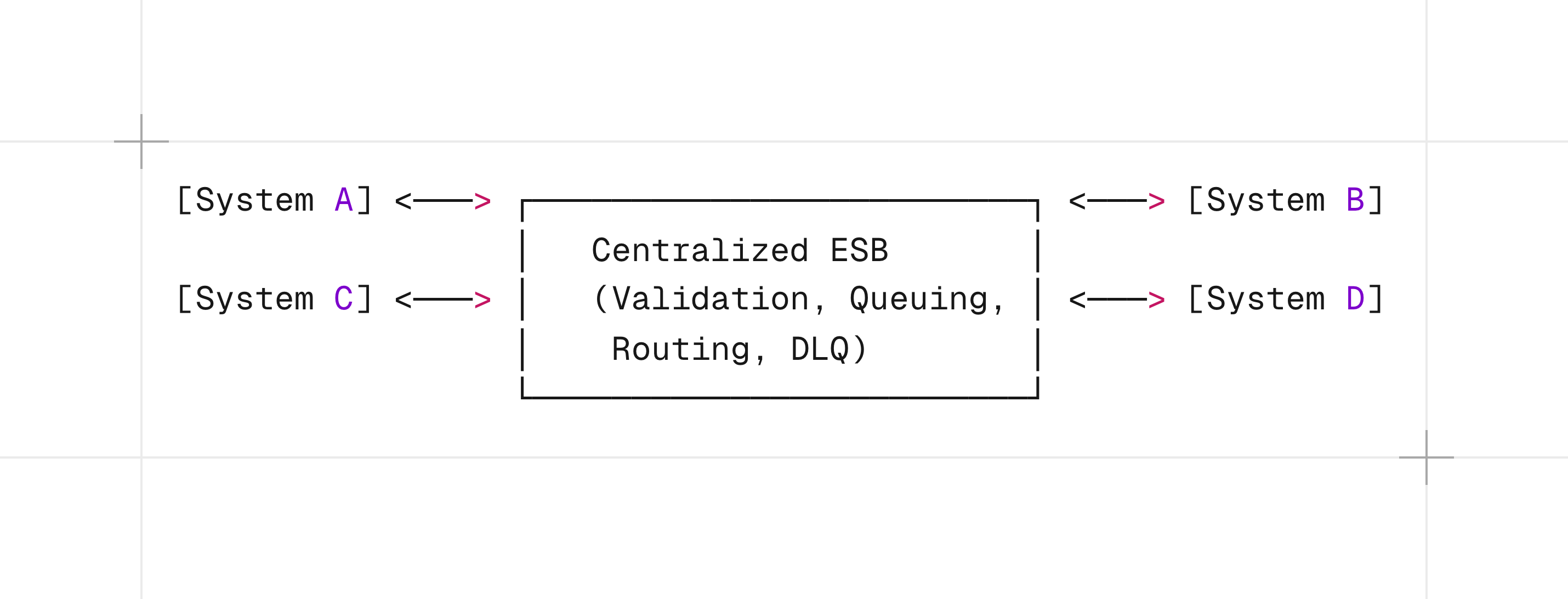
When applied to an Airtable-centric ecosystem, the ESB ensures that Airtable is decoupled from external systems. Rather than visual middleware writing directly to Airtable's raw tables, all data must pass through a governed API Broker/Gateway.
This gateway enforces four essential architectural protocols:
- Schema Validation: The gateway audits incoming payloads against data contracts before they touch the database.
- Rate Limiting & Queuing: The gateway buffers incoming data, writing to Airtable's API using a queue that respects the 5-requests-per-second limit.
- Fault Isolation: If a downstream system (like an email or billing API) is down, the gateway queues the transaction, preventing the failure from halting Airtable operations.
- Observed Dead Letter Queue (DLQ): Every dropped run or failed payload is caught, logged, and surfaced to an administrator interface for manual recovery (detailed in Offloading Resource-Intensive Workloads).
4. Implementation: The API Gateway and Broker Pattern
To build a secure ESB-like broker for Airtable, architects can deploy a lightweight middleware layer using serverless functions (e.g., AWS Lambda, Google Cloud Functions) or enterprise integration platforms configured strictly as brokers.
The following production-ready JavaScript code illustrates a centralized routing broker pattern. The script receives external payloads, validates their schema structure, manages rate-limited writes to Airtable, and routes errors to a Dead Letter Queue (DLQ) if the contract is breached:
-3.png?width=3680&height=13332&name=ray-so-export%20(1)-3.png)
By shifting the integration logic to this broker, the database is shielded from external API volatility. Upstream applications do not talk to Airtable directly, and downstream systems do not depend on Airtable's scripting engine.
The ESB gateway handles the mapping, queuing, and error management, converting integration glue into a robust, enterprise-grade architecture.
5. Architectural Comparison: Integration Glue vs. Centralized ESB
To assist database administrators and operations managers in auditing their active integration footprints, the following matrix contrasts point-to-point integration glue with a centralized ESB Hub-and-Spoke model:
|
Architectural Metric |
Point-to-Point "Integration Glue" |
Centralized Enterprise Service Bus (ESB) |
|---|---|---|
|
Topology |
Spaghetti web of connections ($N \times (N-1)$ complexity). |
Structured Hub-and-Spoke model ($N$ connection complexity). |
|
Data Contracts |
Implicit; changes upstream break downstream processes silently. |
Explicit; enforced validation gates audit payloads before execution. |
|
Rate-Limit Buffer |
None; concurrent writes cause Airtable API throttling (HTTP 429). |
Centralized queue throttling; respects target system rate limits. |
|
Atomic Execution |
Visual actions run sequentially; failures create half-processed records. |
Decoupled state machines; transactions completed or safely isolated. |
|
Fault Isolation |
Downstream outages stall upstream database triggers. |
Event queuing allows delayed delivery; source platforms unaffected. |
|
Observability |
Fractured across multiple platforms; silent errors require manual search. |
Centralized Dead Letter Queue (DLQ) maps all failure events. |
|
Change Control |
Ad-hoc edits applied directly to live endpoints. |
Branching updates verified in staging before API routes deploy. |
6. Securing the Integration Layer
Eliminating integration glue does not require abandoning low-code speed. The agility of Airtable is preserved when its write-paths and API integrations are protected by professional software engineering practices.
By enforcing strict parent-child domains (Act II), setting up programmatic schema validation gates, and routing cross-system events through a centralized API broker, systems architects eliminate silent integration failures.
This ensures that the enterprise ecosystem remains incredibly fast, secure, and fully capable of scaling smoothly under operational load.
Need to Harden Your Integration Architecture?
Visual spaghetti and fragile middleware connections halt business scale. We help enterprise teams decouple ad-hoc integrations and rebuild them into modular, Hub-and-Spoke systems that run securely.
Schedule a Discovery Call with InAir →