 ·
4 minute read
·
4 minute read
Airtable allows rapid operational deployment; however, as bases multiply without governance, the lack of visual coordination can breed architectural debt. As established in the Enterprise Airtable Architecture Foundations, scaling database ecosystems requires moving beyond flat spreadsheet sharing habits toward strict, unidirectional data replication.
In systems engineering, spaghetti architecture is defined as a structural anti-pattern where undocumented point-to-point connections and tight database coupling create a tangled web of dependencies; this design failure increases technical debt and makes the system impossible to safely audit. In enterprise environments, this invisibility results in silent failures. When an application manager reviews integration logs, the execution shows a successful state; yet, downstream systems contain mismatched records and stale values because the underlying schema lacks a visual topology. To map these dependencies, IT architects rely on standard data lineage tracking protocols to document where each attribute originates.
Because Airtable makes base creation and table syncing so accessible, builders sometimes connect bases in ad hoc patterns that degrade into unmapped dependencies. This article provides a diagnostic breakdown of how spaghetti architecture develops within these Airtable environments, analyzing how undocumented tables and circular sync loops degrade your database system; it outlines the exact steps operations architects take to untangle these setups using Entity Relationship Diagrams (ERDs) and configurable scripting, complementing the access controls detailed in Why Base-Level Permissions Create Enterprise Vulnerability.
The Pathology of Circular Sync Loops
Circular synchronization represents the most critical failure of database record authority; it occurs when data flows through two or more bases in a closed loop. For example, Base A syncs product details to Base B; Base B updates shipping states, and an automation in Base B writes those updates back to the original record in Base A to enrich it. There are operational scenarios where a sync back enrichment like this is legitimately required; however, the failure mode occurs when a writeback automation overwrites a field on Base A that other sources also write into directly on Base A.
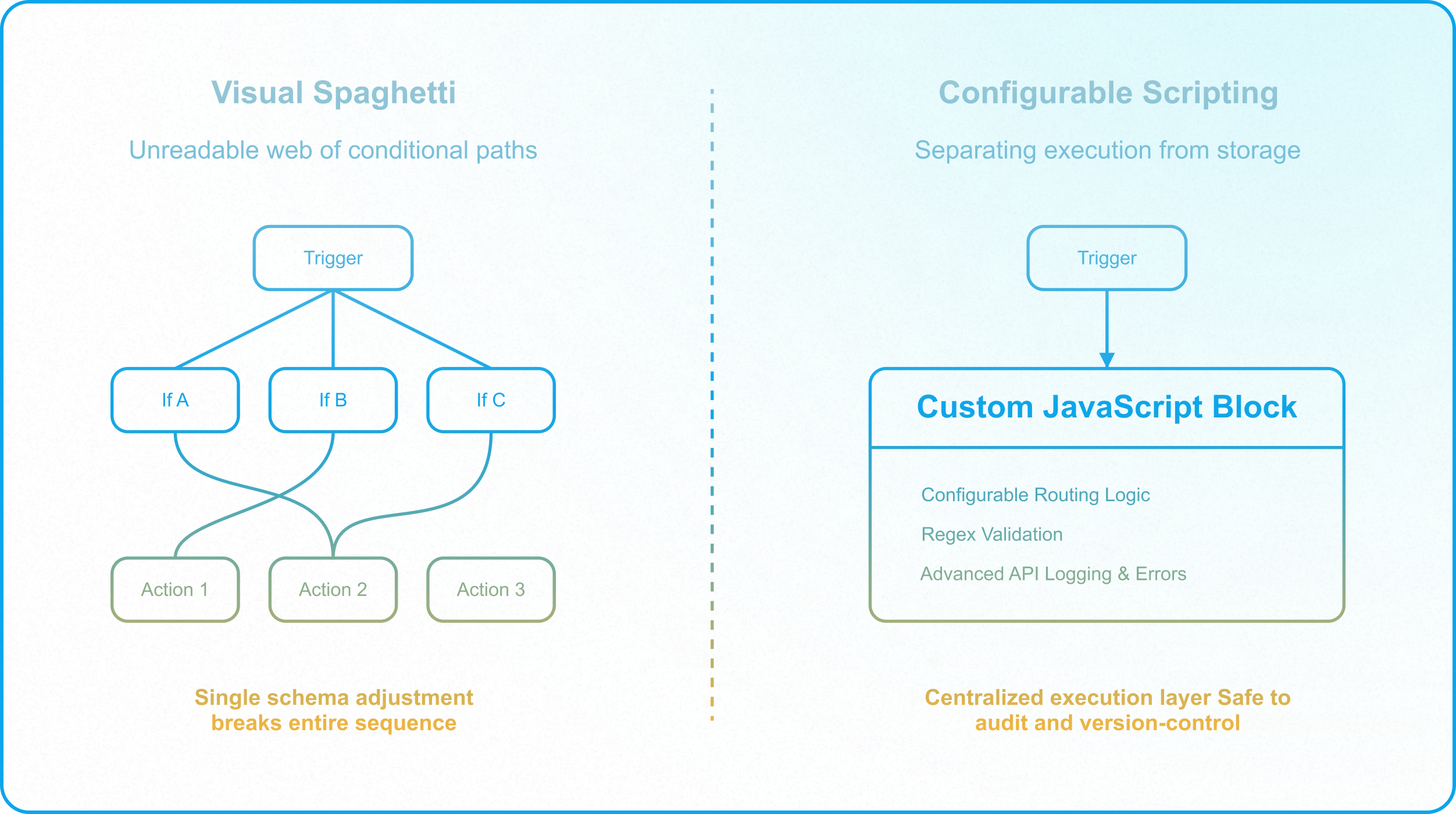
To implement a governed sync back enrichment, systems architects ensure that the writeback automation lands in a separate, read-only operational enrichment table on Base A; this separate table links back to the parent table, creating a relational projection that allows operators to view the child data alongside the parent record without permitting direct edits or overwriting core parent fields. Because Airtable Sync is designed for unidirectional, read-only replication, attempting to build two-way update loops across bases creates a race condition where sync latency and automation delays collide. The asynchronous nature of the sync engine means that updates are written based on stale cached data, causing collisions that overwrite authoritative fields; this represents a failure to establish a singular source of authority, which is detailed further in The Dangers of Circular Syncs in Airtable.
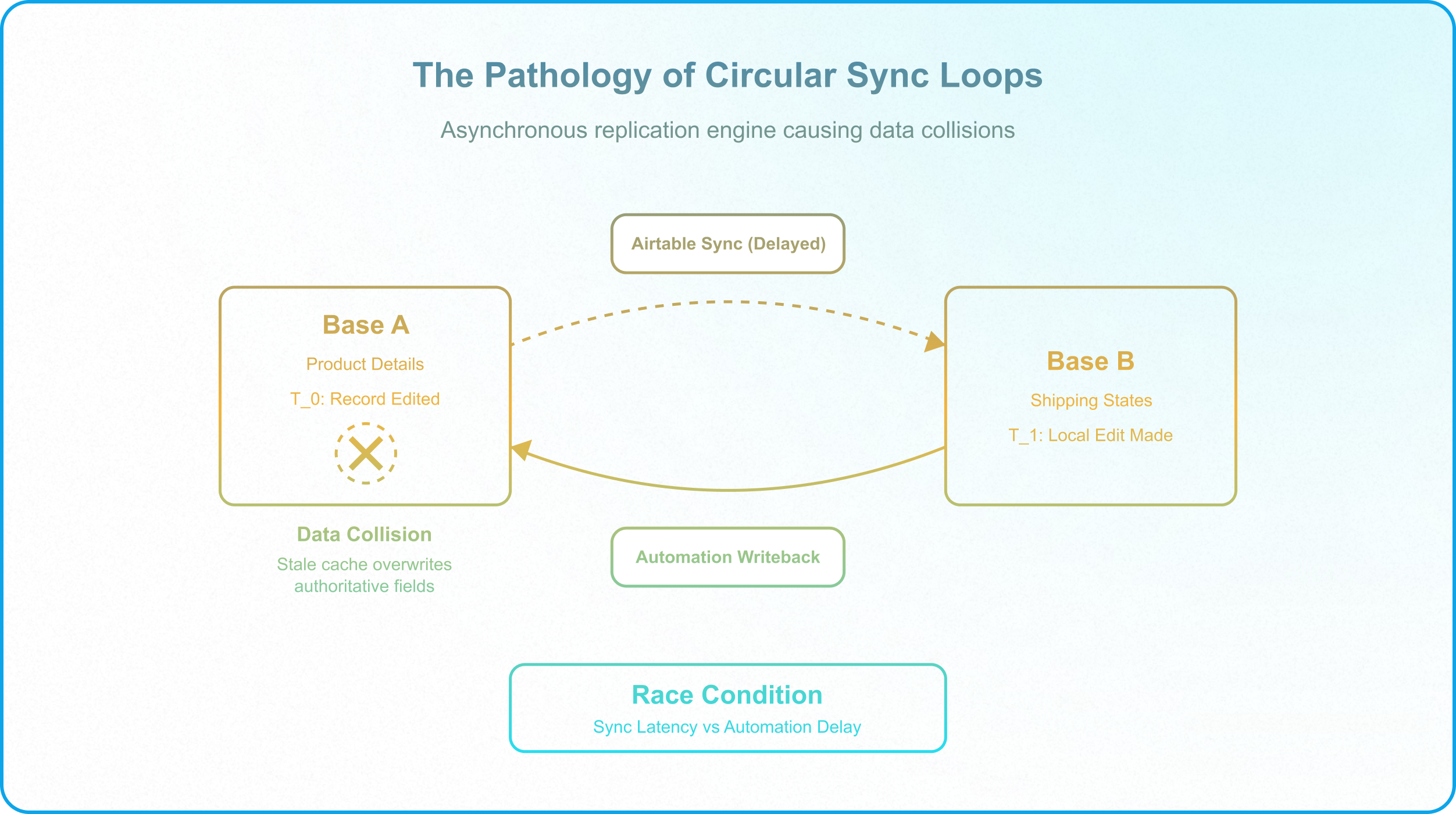
Because Airtable Sync is designed for unidirectional, read-only replication, attempting to build two-way update loops across bases creates a race condition where sync latency and automation delays collide. The asynchronous nature of the sync engine means that updates are written based on stale cached data, causing collisions that overwrite authoritative fields; this represents a failure to establish a singular source of authority.
To resolve this, systems architects enforce the concept of Martin Fowler's Bounded Contexts to isolate operations into sovereign data domains. Each database entity must have one designated parent base that owns its write path; all downstream bases must consume this data as read-only syncs without attempting to write back to the parent base through secondary sync loops.
Important: to maintain operational integrity, systems must align with the separation of concerns as defined in Airtable Access Matrix.
Visual Spaghetti vs. Configurable Scripting
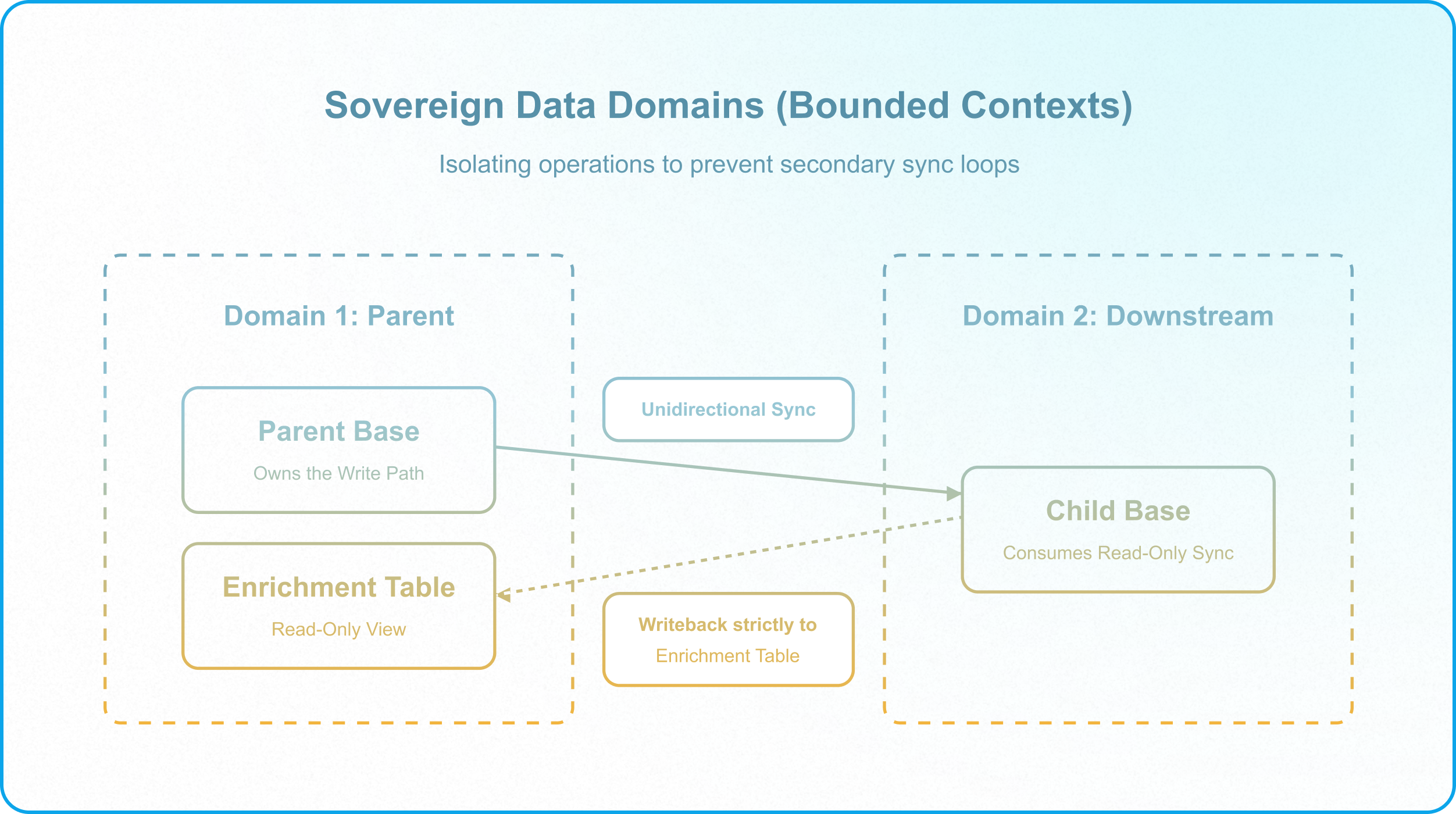
Relying exclusively on visual builder blocks for complex routing in automations leads to visual spaghetti; this is an unreadable web of conditional paths that no systems manager can safely audit, version-control, or modify. When a builder strings together dozens of native visual actions, a single schema adjustment breaks the entire sequence.
Enterprise operations require separating the execution plane from the data storage plane. This separation aligns with the AWS Database Decoupling Architecture Pattern where compute layers are isolated from storage layers. By moving logic into custom JavaScript automation scripts, a single code block executes the payload; this allows architects to configure advanced error handling, regex validation, and API logging that visual blocks cannot support.
Transitioning to configured scripts simplifies the execution layer, reducing the number of active automation slots and preventing builders from exceeding the fifty automation limit per base. It ensures that when schema updates occur, the changes only need to be adjusted in a centralized code block rather than across dozens of fragmented visual actions.
Diagnostic Governance: The Entity Relationship Diagram (ERD)
Untangling a distributed database requires visual governance; the Entity Relationship Diagram serves as an active diagnostic tool. Before modifying a live production schema, the architect must consult the ERD to trace data lineage. Operations leaders can consult the IBM Entity Relationship Diagram Guide to establish standard modeling notations for their databases.
For example, during the design of the global campaign hub for Riot Games, regional production teams systematically duplicated master campaign bases to meet local deadlines. Because they lacked a visual map of the data topology, the global pipeline degenerated into spaghetti architecture, leading to fragmented workflows and version control failures; the implementation of a unified ERD allowed the team to consolidate bases, map asset lineage, and secure downstream operations.
By requiring all schema updates to be visualised on the ERD first, the system enforces a strict operational gate, preventing structural debt from entering the ecosystem. It allows operations leaders to perform impact analyses, proving that modifications in a parent table will not break downstream synchronizations or integrations.
The Untangling Protocol
To resolve spaghetti architecture, systems architects execute a five-step untangling protocol:
- Inventory base boundaries: Catalog every active base in the workspace, identifying the departments that use them and the specific business processes they support.
- Trace sync pathways: Map every synchronized table, documenting the source base, the destination bases, and the fields included in the sync view.
- Consolidate circular syncs: Identify closed loops where synced data triggers an automation to write back to its source table; replace these loops by moving the fields to the authoritative parent base and routing all updates through governed interface pathways that target the parent base directly, which are mapped in the Data Responsibility Map and the How to Build Controlled Interface Pathways.
- Transition visual automations to scripting: Replace complex, multi-step visual workflows with single, well-documented JavaScript automation scripts that run asynchronously in the background.
- Lock sync views: Enforce view locking in source bases to prevent operators from modifying filter criteria or hiding columns, protecting downstream data contracts from accidental breakage.