 ·
8 minute read
·
8 minute read
At enterprise scale, data integration is not merely a convenience—it is a formal dependency. As organizations scale their internal tool footprints, they increasingly rely on platforms like Airtable to connect distributed departments. By utilizing native synchronization features, systems architects can share data across bases to link opportunity pipelines, financial records, and operational deliverables.
However, treating these synchronization pathways as simple, ad-hoc connections is a primary driver of system failure. In many environments, a builder configures a sync view, shares it with a downstream base, and considers the integration complete. This approach ignores a critical database reality: Airtable Sync is a replication pipeline, and any unmanaged change to its schema is a breaking API modification.
When an upstream team renames a field, deletes a column, or alters a single-select option, the change ripples downstream. Downstream automations fail, lookup values disappear, and critical operational pipelines halt.
If a creator renames a field in Airtable or alters a select option (e.g., from In Progress to Processing), the platform permits the change on the fly. While native Airtable Syncs survive this rename by keeping the existing mapped field name downstream, ad-hoc external integrations (like point-to-point middleware referencing fields by name) break silently. Because the visual middleware lacks compile-time validation, the pipeline continues to execute:
- The connector passes empty values or defaults to downstream systems because the expected field name is no longer found.
- Scripting steps referencing the legacy field name fail to resolve, dropping the payload entirely.
To achieve enterprise-grade reliability, systems operations managers and database architects must treat every Airtable Sync as a formal data contract. By establishing strict schema validation gates, locking view signatures, and managing change through staging base environments, organizations can protect their operational workflows from cascading integration failures.
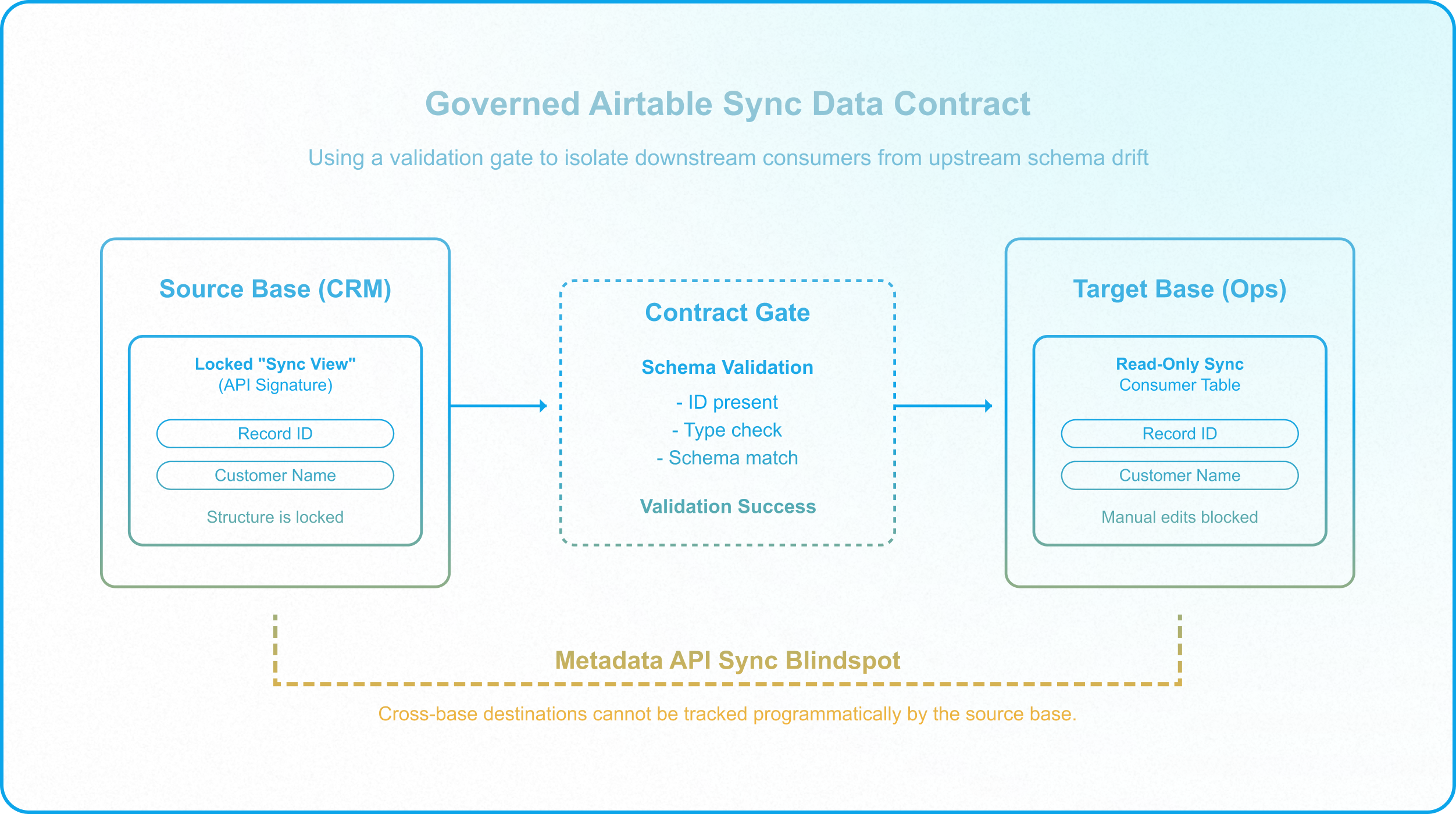
- Left: Source Base CRM Table with a dedicated, locked "Sync View" representing the API Signature.
- Center: A yellow "Contract Gate" containing a checklist (ID check, presence validation, schema match) and a green checkmark indicating validation success.
- Right: Target Base Operations Table consuming a read-only sync, with a warning tag outlining blocked manual downstream edits.
- Bottom: A dashed red line highlighting the Metadata API Sync Blindspot, pointing out that cross-base sync destinations cannot be tracked programmatically.
- Style: Clean, flat vector layout using navy (#014165), steel blue (#538DA5), and magenta (#D44378) highlights.
1. The Fallacy of the "No-Cost" Sync: Treating Replication as an API
Airtable's user interface makes database synchronization feel instantaneous and risk-free. Once a creator in a source base shares a sync link for a specific view, a creator in a destination base can subscribe in a few clicks. Under the hood, however, Airtable Sync is an eventually consistent replication engine, not a real-time transactional connection.
The real risk is directional. Once subscribed, destination creators can build on data they don't own — mapping it into formulas, views, and critical automations — while the source owner has no visibility into those dependencies. A routine change on their end, like restructuring the view, can silently break downstream automations in a destination base they don't even know exists.
The Automation Exhaustion Risk
In an attempt to bridge the gaps created by sync latency, citizen developers often write complex circular automation loops that trigger on every record sync. If Base A syncs to Base B, and Base B runs an automation that writes back to Base A, the write-back triggers another sync.
This circular cascade rapidly exhausts the workspace’s monthly automation run budgets, halting all database automations across the entire enterprise (as modeled in the structural failure analysis in The Dangers of Circular Syncs in Airtable).
To prevent these failures, architects must treat every sync view as a formal REST API endpoint. A sync is a structural promise that the source base will provide data in an immutable shape, and that the target base will consume it strictly as read-only.
The Two-Way Sync Write-Path Risk
The biggest risk of enabling native two-way sync is that it opens a large, uncontrolled write path into the parent record. Once write-back is enabled, users on the receiving base can edit the source base's data, and the owner of the sync-out base has no control over where or how those edits are made. This is dangerous precisely because the receiving base can't see what it's affecting.
Even a diligent destination owner who sets up proper input interfaces and validation cannot see or access the parent base, nor the automations, rollups, and formulas that may depend on the fields they're now writing to. An edit that looks routine on the receiving side can silently alter values that authoritative logic in the parent base relies on, with no warning to the editor or the builder of the destination base.
To contain this, architects should treat every sync view as a formal, version-controlled interface between bases. Although Airtable supports two-way sync natively, the more robust enterprise practice is to default to unidirectional parent-to-child replication: the source base provides data in a stable shape, and the target base consumes it as a read-only mirror. Where write-back is genuinely required, route it through a controlled, well-understood input surface rather than opening ad-hoc sync write access to fields that carry downstream dependencies.
2. Upstream Schema Drift and the Metadata API Blindspot
The most common cause of sync failure is schema drift: unplanned, undocumented modifications such as deleting columns, hiding fields from the sync view, changing data types, or altering select options in the source table. Because Airtable has no compiler to catch structural changes, these errors manifest silently at runtime.
Silent Cascading Breakages
Consider an upstream sales team that manages a master CRM base. An administrator decides to rename the field Client_Tier to Account_Level for visual clarity, or changes a single-select option from Enterprise to Tier 1.
Because Airtable permits these changes on the fly, no warning is issued to the administrator. However, downstream in the Operations base:
- Synced lookup fields mapping to Client_Tier suddenly return empty values.
- Downstream JavaScript blocks referencing the literal string "Enterprise" fail to execute.
- Integrations connected to Slack or external ERPs throw unhandled errors, severing the workflow pipeline.
The Metadata API Constraints
In traditional software environments, developers manage API dependencies using service registries or programmatic dependency mapping. In Airtable, this is physically impossible.
Airtable's Metadata API does not expose cross-base sync sources or downstream target destinations.
An administrator looking at a source table cannot run a script to see which downstream bases are currently subscribed to its sync views. Because the platform does not expose these target destinations, any attempt to map base dependencies programmatically will fail.
As a result, database architects must manually audit and catalog all sync pathways in a centralized registry (such as a master JSON configuration or an Entity Relationship Diagram, as detailed in Spaghetti Architecture). Before modifying any upstream field, the architect must reference this manual registry to perform an impact analysis, verifying that the change will not break downstream consumer tables.
3. The Architecture of a Data Contract
To enforce stability across distributed bases, organizations must implement formal data contracts. A data contract is a shared agreement between the data producer (the upstream base) and the data consumer (the downstream base) that defines the schema, value constraints, and SLA of the replicated data.
We enforce this contract using a four-tier architecture:
Component 1: The Authoritative Source Base (Producer)
The base that holds the single source of truth for the entity. All write permissions for core fields are restricted to this base. No downstream base is permitted to modify this data directly.
Component 2: The Locked Sync View (API Signature)
The synchronization source must be a dedicated view, never a general working grid. This view represents the API Signature.
To prevent accidental modifications, the view must be locked using Airtable's native View Locking feature. This prevents general collaborators from changing filters, hiding fields, or modifying sort criteria. The lock description should state the downstream bases dependent on the view, serving as a secondary visual warning.
Component 3: The Minimum Viable Sync (MVS) Schema
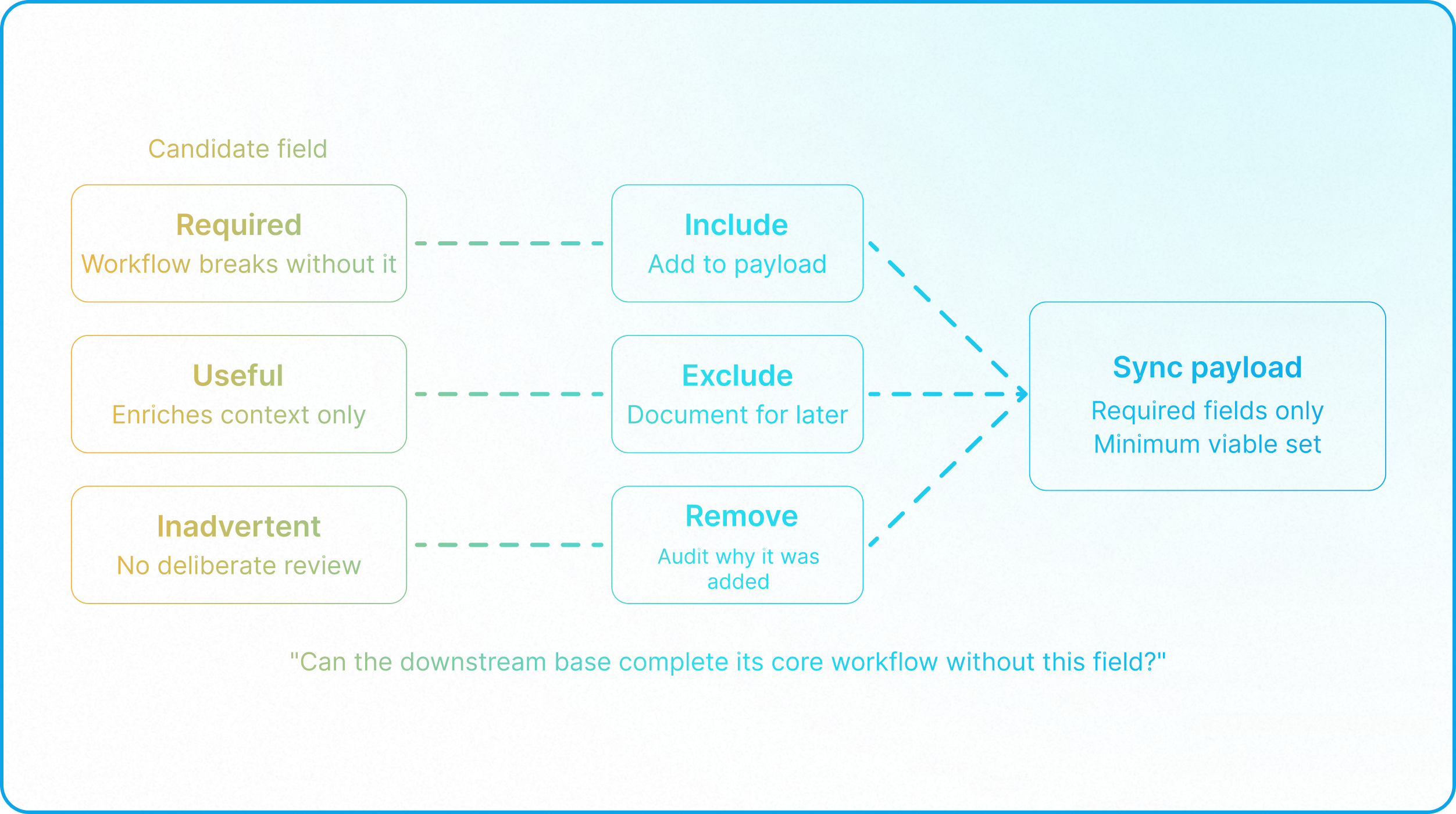
A data contract must be as narrow as possible. When syncing data from the CRM base to the Operations base, builders frequently sync the entire table. This horizontal column creep introduces structural debt and exposes downstream systems to unnecessary schema drift (analyzed in Cluster 5: The Illusion of Maintainability in No-Code Systems).
Architects must enforce the principle of Minimum Viable Sync (MVS), as outlined in the Enterprise Airtable Architecture Foundations. Sync only the absolute minimum fields required downstream (e.g., Record ID, Customer Name, and Lifecycle Status). If the downstream team does not need a field to execute their daily workflow, that field must be excluded from the sync view contract.
Component 4: The Consumer Base (Internal Department / Operator)
The downstream base subscribes to the synced table as a read-only mirror. To protect sensitive fields (such as private financial details) and prevent data leakage, internal operators must interact with this data exclusively through curated Interface layouts (such as List or Grid views with "Click into record details" enabled, avoiding raw grid base access).
Because all base-level collaborators possess export privileges and can download tables as CSVs, inviting users strictly as Interface-Only collaborators is the only way to block raw database exports and secure the data egress path (detailed in Why Base-Level Permissions Create Enterprise Vulnerability).
4. Implementation: Enforcing Schema Validation Gates
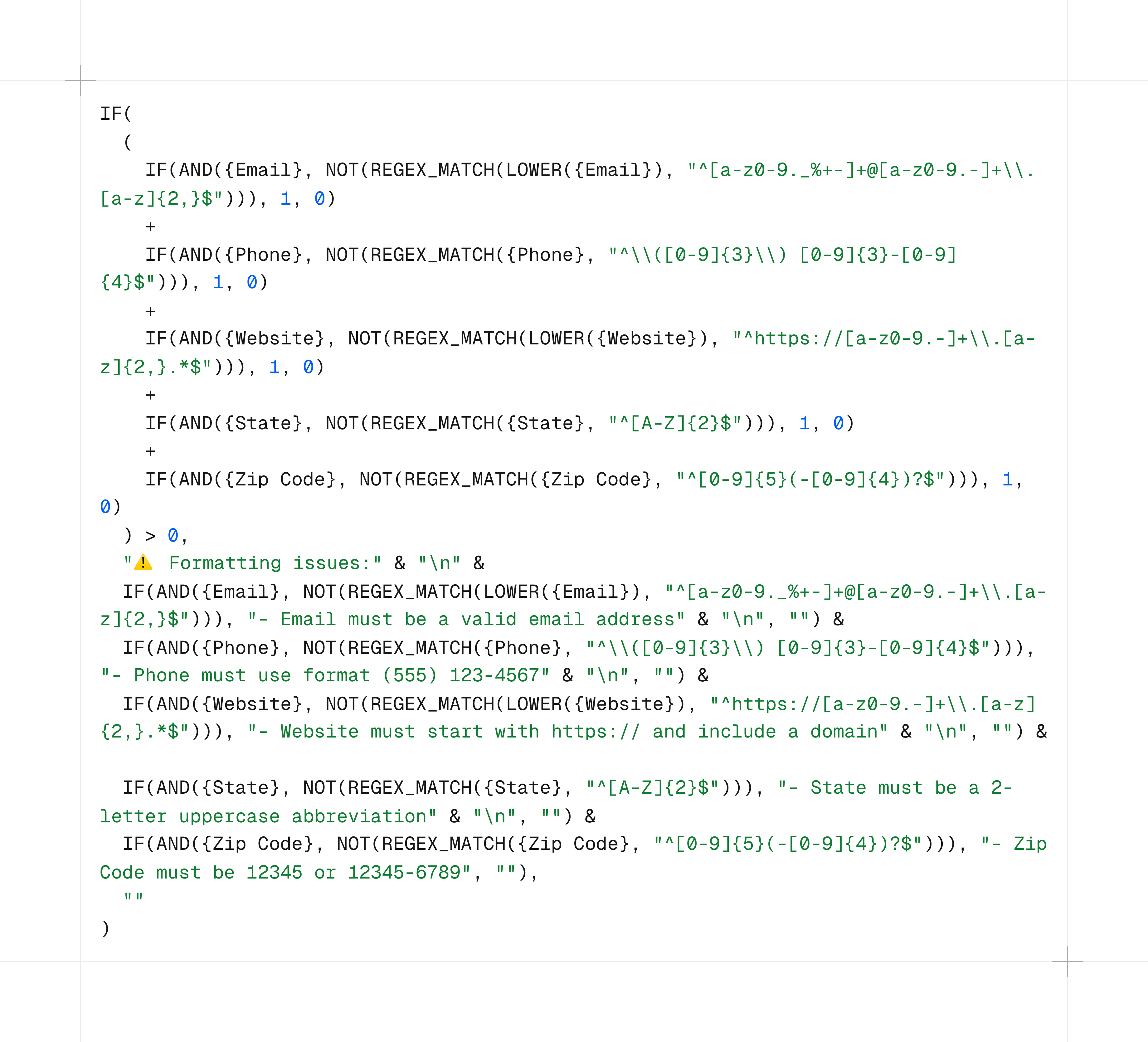
To ensure that records entering the sync pipeline strictly adhere to the data contract, architects should deploy an automated Schema Validation Gate. Rather than allowing records to enter the sync view automatically, records are held in a "Pending" state until a scripting block verifies their schema structure and data integrity.
The Validation Workflow:
- State Initiation: A record's status changes to Ready_For_Sync.
- Validation Trigger: An automation runs a scripting block to audit the record.
- Contract Verification: The script checks that all required fields exist, contain values matching expected lengths, and adhere to formatting rules.
- Enforcement:
- If the record passes, the status changes to Approved, moving it into the locked sync view.
- If the record fails, the status is flagged as Schema Error, the record is excluded from the sync view, and the validation errors are written to an error log for administrator review.
By using this formula-driven gate, you establish a real-time, zero-cost firewall. The database automatically audits itself on every character stroke, alerting administrators to data contract violations instantly without disrupting downstream relational mappings.
5. Change Control: Staging-to-Production Workarounds
Because Airtable lacks native SQL-like database migrations and schema version-control controls, executing schema updates in a live environment is risky. To safely modify a data contract schema, architects must deploy a Staging Base Workaround mapped across a four-phase rollout sequence:
[Phase 1: Addition] ──> [Phase 2: Alignment] ──> [Phase 3: Deprecation] ──> [Phase 4: Deletion]
- Phase 1: Addition (Non-Breaking): Add the new field to the upstream production table. Do not delete or rename the old field. Update the validation script contract gate to permit the new field, but keep it optional.
- Phase 2: Alignment (Downstream Update): Modify the locked sync view to include the new field. In the downstream consumer bases, update automations, scripts, and interface elements to reference the new field instead of the legacy field.
- Phase 3: Deprecation (Observation Period): Change the legacy field's name to DEPRECATED_FieldName as a visual warning. Keep the field populated, but stop writing new data to it. Monitor downstream execution logs for 7–14 days to confirm that no active script or webhook is still requesting it.
- Phase 4: Deletion (Clean-up): Remove the deprecated field from the upstream source base and delete its validation rules from the contract gate script. This completes the migration with zero downtime or sync severances.
6. Architectural Comparison: Ad-Hoc Sync vs. Contract-Governed Sync
To assist database administrators in auditing their synchronization pipelines, the following matrix contrasts the characteristics of ad-hoc sync configurations with governed enterprise sync contracts:
|
Architectural Dimension |
Ad-Hoc Sync (Unregulated) |
Contract-Governed Sync (Enterprise Standard) |
|---|---|---|
|
Pipeline Authority |
Bidirectional loops attempting back-enrichment write paths. |
Strictly unidirectional parent-to-child replication. |
|
View Configurations |
Shared working views; filters/fields can be modified by any Creator. |
Dedicated, locked Sync Views representing the API signature. |
|
Payload Optimization |
Horizontal column creep (syncing all fields "just in case"). |
Minimum Viable Sync (MVS); syncing only required operational fields. |
|
Dependency Lineage |
Unmapped; changes applied directly to live base schema. |
Documented in a manual registry; updates tested in staging. |
|
Replication Security |
Wide base access; raw grids open to CSV data exports. |
Interface-only collaborator access; raw database grids blocked. |
|
Validation Layer |
None; human input errors pass directly to consumer bases. |
Programmatic Schema Validation Gates blocking invalid payloads. |
|
Change Control |
Destruction via snapshots; direct renaming on production bases. |
Controlled Addition -> Alignment -> Deprecation -> Deletion sequence. |
Conclusion: Enforcing Structural Rigor
The speed of low-code development is a double-edged sword. While it allows teams to establish connections quickly, the absence of strict compiler warnings encourages fragile database configurations. In enterprise environments, database systems are only as stable as their integrations.
By treating Airtable Syncs as formal API contracts, systems operations leaders protect their workspaces from the consequences of schema drift. Enforcing dedicated locked views, programmatically auditing record schemas before replication, and utilizing structured staging rollover sequences prevents sync failures. This ensures that Airtable remains a robust, governed operational layer capable of supporting enterprise-level operational scale.