 ·
4 minute read
·
4 minute read
When builders carry the two-dimensional mindset into Airtable, they don't just build messy workflows: they actively destroy their system's capacity. As we established in, a spreadsheet flattens reality. When you apply that flat mindset to a scaling database, you inevitably fracture your operations.
Most Airtable implementations do not fail because of technical platform limitations; they fail because of schema fragmentation. When a base lacks strict architectural governance, it quickly devolves into a massive spiderweb of disconnected data silos.
Here are the three structural rules required to break the two-dimensional mindset and design a unified core schema before you collide with Airtable's hard data limits.
1. The Bloat Trap: Normalization as a Hard Capacity Limit
Airtable Enterprise caps standard bases at 500,000 records. While that sounds massive, a two-dimensional mindset will burn through that ceiling in months.
Airtable Enterprise caps standard bases at 500,000 records. While that sounds massive, a two-dimensional mindset will burn through that ceiling surprisingly fast because of how data is distributed.
When a citizen developer builds a new departmental workflow, they instinctively duplicate existing data by syncing entire, unfiltered tables into their new base. For example, if your company has a master list of 200,000 prospects and customers, and the Billing team simply syncs that entire table into their new Billing base, they have instantly wasted 40% of their available capacity on data they do not even manage. Once they start generating hundreds of thousands of invoice records on top of it, the base hits its ceiling and breaks.
The architectural solution is intentional, with filtered data boundaries. A Billing base should not house the entire sales pipeline; it should only sync a strictly filtered View of customers who have actually reached "Paying" status. By restricting data movement to only what a department strictly needs to operate, you preserve the base's computational capacity for its actual purpose.
Database Normalization is the architectural mandate that outlaws this duplication. By forcing all customer data to live in a single, centralized directory, you preserve server space and keep the base computationally lean. Normalization is not just an organizational preference; it is the physical requirement to prevent your base from bloating out of its enterprise limits.
2. The Architectural Threshold: Views vs. Tables
The hallmark of a two-dimensional mindset is confusing a "business process" with an "entity type."
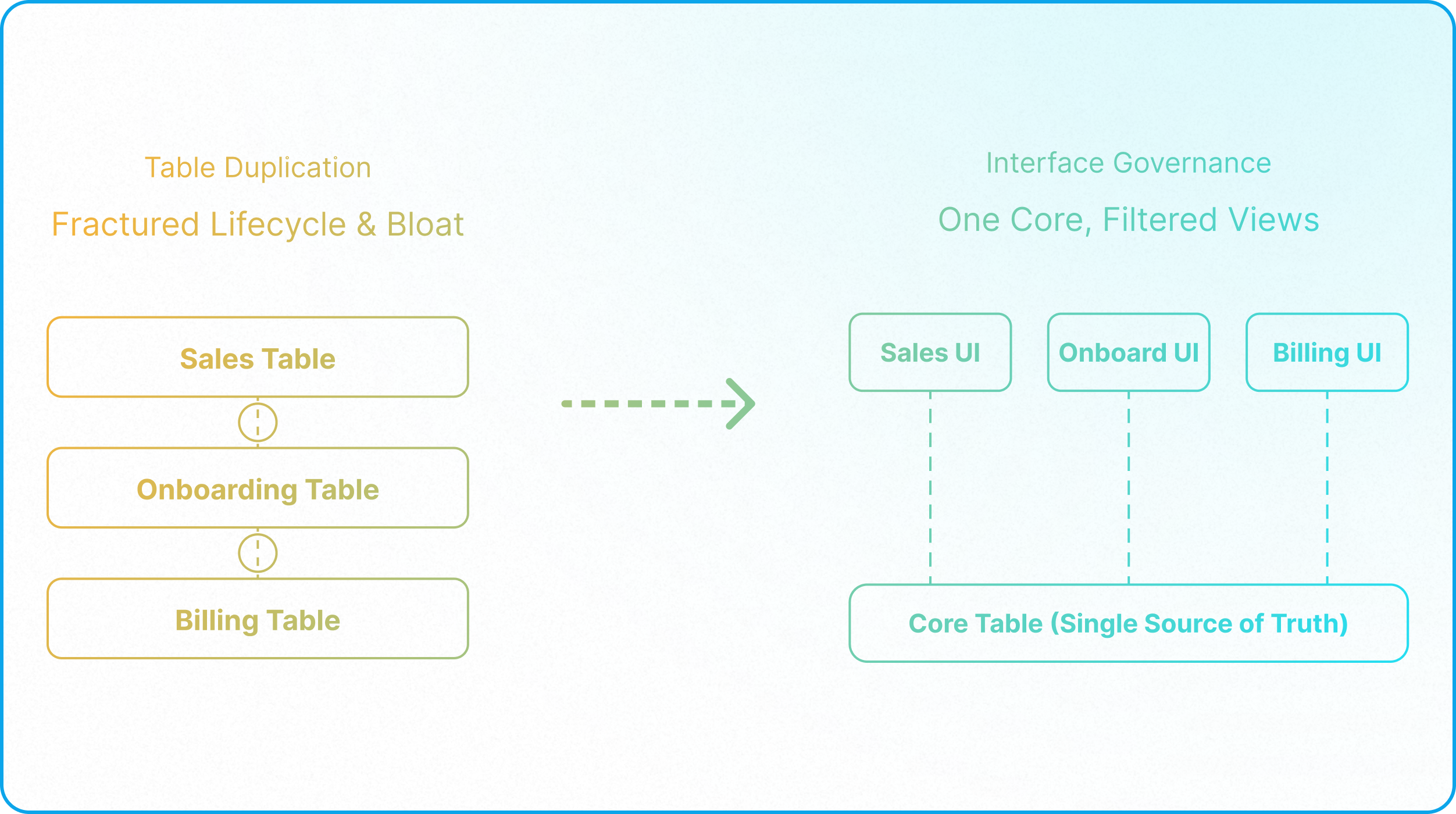
When an operations team wants to manage customer onboarding, they typically spin up a brand new table titled "Onboarding." This is a structural failure. "Onboarding" is a temporary process, not a permanent data type. When you create dedicated tables for temporary processes, you fracture the client's lifecycle across multiple tabs, accelerating the system collapse we outlined in.
A citizen developer might try to solve this using Filtered Views. The client remains in the core "Customers" table forever. The architect simply creates a View filtered by Status = In Onboarding. The Operations team gets a dedicated workspace for their exact process, but the underlying data never moves.
On the other hand, an architect builds a dedicated Interface page for the Operations team, applying that exact same filter logic in the background (e.g., Status = In Onboarding). The operations team gets a streamlined, governed workspace tailored exactly to their process, and they never have to touch or risk breaking the fragile backend data layer.
The ironclad rule of base governance: a new Table is only authorized when you are introducing an entirely new entity to the system. If you are just tracking a different phase of an existing entity's lifecycle, you deploy an Interface page.
3. The Gravitational Center of the Schema
A two-dimensional mindset assumes every department owns its own distinct set of data. But an Enterprise Airtable Architecture operates like a solar system; it requires a gravitational center.
In most B2B operations, the core "Projects" or "Clients" table acts as the sun. Every other table in the base must orbit that center. When a rogue department demands a custom tracking workflow (for example, a "Legal Risk Review" log), that new table cannot exist in isolation. It must be structurally tethered back to the core schema.
By enforcing a strict Single Source of Truth, you guarantee absolute operational visibility. If an executive clicks on a client record, they should instantly see every legal review, project milestone, and billing update orbiting that client. If a new table cannot structurally trace its lineage back to the schema's gravitational center, it is a rogue satellite and a liability.
The Schema Fragmentation Audit
A scaling enterprise cannot survive on fragmented data. Before your base collides with its hard record limits, run your current architecture through this strict 3-point diagnostic test to identify rogue silos:
1. The Table vs. View Test: Review your list of Tables.
- Do you have any tables named after a temporary process rather than a permanent object? (e.g., “Pending Approvals” or “Onboarding Tracker”).
- If so, you have fractured your data lifecycle. Collapse those tables into your core schema immediately and rebuild the process using filtered Views.
2. The Gravity Test: Pick a random record in one of your peripheral tracking tables.
- Can you structurally trace that record back to the primary key of your core "Clients" or "Projects" table via a Linked Record?
- If it operates in total isolation, it is a rogue satellite. You must tether it to your gravitational center to establish a single source of truth.
3. The Duplication Test:
- Does an operator ever have to manually type a client's name or copy a project status across multiple tables?
- If yes, you have violated Database Normalization. You must convert that data point into a strict Entity so it can be referenced optically, rather than duplicated manually.
If your base fails any of these three checks, you are not running a relational architecture; you are managing a very expensive spreadsheet.
If that is the case, your immediate next step is to freeze all new table creation. You must halt the bloat, conduct a full schema audit, and begin collapsing your rogue silos back into filtered Views.
If you do not have an internal team capable of re-architecting your data model without breaking live operations, you need to bring in dedicated Airtable consultants. Do not wait until your base hits a hard capacity limit to start untangling the web. If you need a team of enterprise architects to safely execute the consolidation, InAir specializes in unifying fragmented silos into high-capacity, fully integrated operational engines.