
 ·
2 minute read
·
2 minute read
Airtable revolutionized enterprise operations by giving business teams something unprecedented: the power to build custom relational software visually, within minutes. By removing the friction of traditional engineering, teams can instantly launch trackers, connect workflows, and bypass IT bottlenecks entirely.
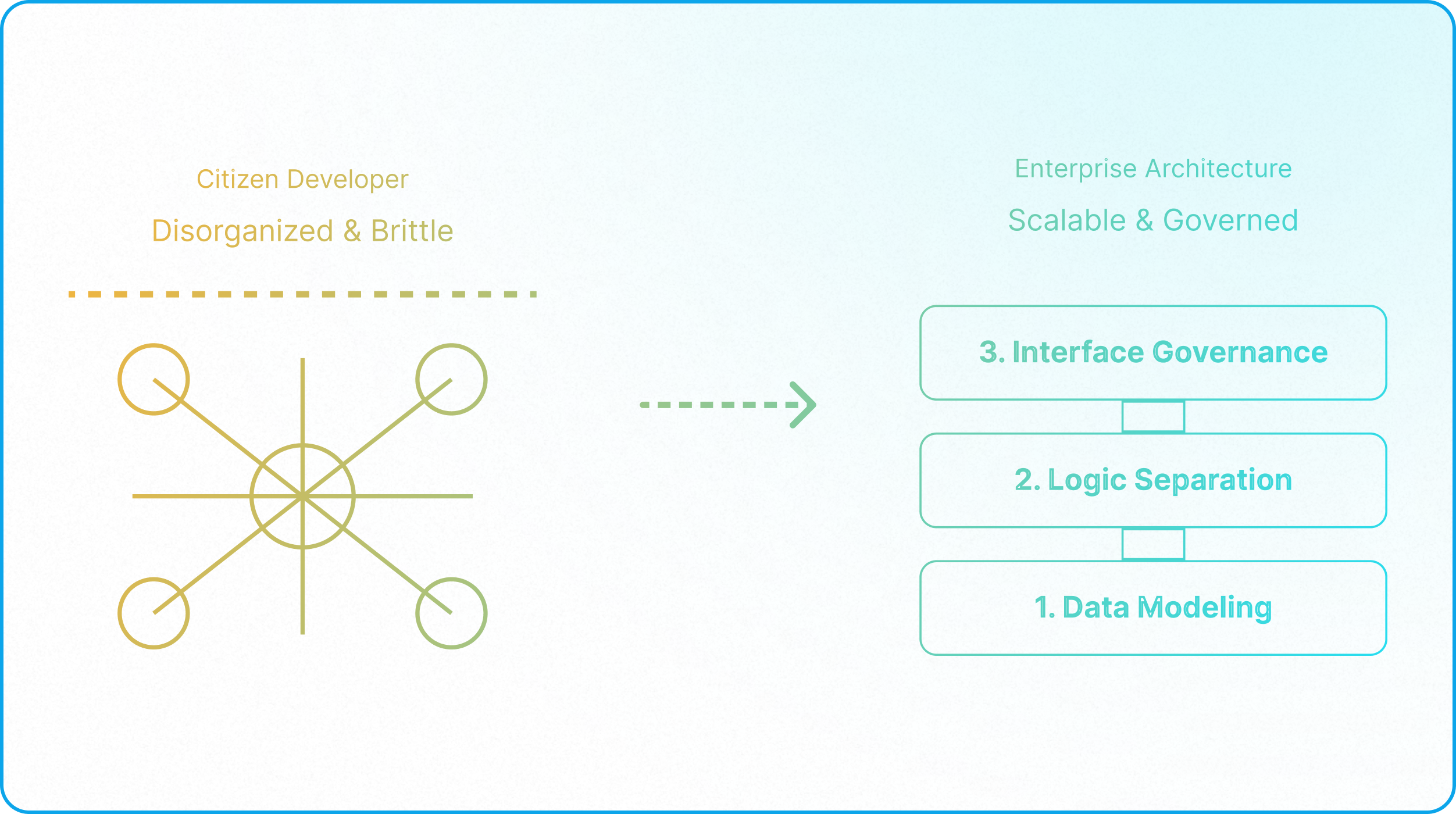
But this accessibility comes with a hidden cost. When an organization expands its footprint organically, rapid builds must eventually evolve into governed infrastructure. Below, we break down the exact mechanics required to bridge the gap between a fast operational build and a robust, governed system, allowing you to scale Airtable into a resilient, enterprise-grade machine.
The Citizen Developer Ceiling
In the early stages of a company’s growth, the citizen developer is an undeniable asset. Because Airtable requires zero code to launch, operations leaders can build their own solutions to get the company off the ground. That DIY build likely saved your operations early on.
But the physics of scale inevitably change. Citizen developers naturally optimize for immediate convenience. When a new workflow emerges, the instinct is to spin up an isolated tracker or endlessly append fields to a single grid. Because these builds lack an intentional, central data model, the workspace naturally accumulates severe technical debt.
The system hits a ceiling. The environment fills with disconnected databases and overlapping automations. The internal builder eventually becomes trapped, spending their days patching a brittle schema rather than accelerating the business.
The Mechanics of Scale
Scaling Airtable is not about adding more tables or fields; it is about centralizing logic so the architecture itself does the heavy lifting. Transitioning to a formal Enterprise Airtable Architecture requires executing three core mechanics:
1. Foundational Data Modeling (Normalization)
You cannot treat Airtable like a digital whiteboard and expect it to behave like a relational database. The ultimate defense against technical debt is database normalization.
In operational terms, normalization means your team stops manually updating the same client address in three different trackers. You eliminate data redundancy so that every operational fact exists in exactly one place, acting as the definitive single source of truth. You update the source entity once, and that data instantly cascades perfectly through every connected dashboard and report.
2. Logic Separation and Base Boundaries
A single base cannot hold the entire operational weight of a company. Centralizing all workflows into one environment creates a massive Single Point of Failure (SPOF). A mature architecture distributes power by drawing strict Base Boundaries.
By enforcing the engineering principle of Separation of Concerns, you establish a controlled "blast radius." Strict base boundaries mean that a junior marketing coordinator cannot accidentally delete the company's master financial ledger. Departments regain sovereign control over their own workflows without ever risking the security of another team's architecture.
3. Interface Governance
A flawless data model means nothing if operators can casually override the logic on the backend grid. True governance dictates that regular team members interact with the database exclusively through highly restricted Airtable Interfaces.
An Interface is not just a reporting dashboard; it is a rigid operational boundary designed to enforce your Standard Operating Procedures (SOPs). By deploying Interfaces as controlled input surfaces, the system physically blocks bad data. It removes the "Submit" button if an operator forgets to upload a required compliance document, permanently protecting your data integrity at the source.
When to Bring in an Architect
There is a distinct line between building a tracker and engineering a system. You stop relying on internal builders when your operations demand infrastructure.
When a company requires strict security boundaries, cross-base data hierarchy, and governed access matrices, an architect steps in to lock the core schema. You lock the backend database so your operations team can finally move at maximum velocity on the frontend, without the fear of breaking the company.
Providing that elite architectural governance is exactly what InAir does. We engineer relational systems specifically to scale Ops and RevOps teams to ensure absolute trust in your data. If your workspace has hit the citizen developer ceiling, schedule a Discovery Call with InAir to transition your workflows into a true enterprise system.