 ·
3 minute read
·
3 minute read
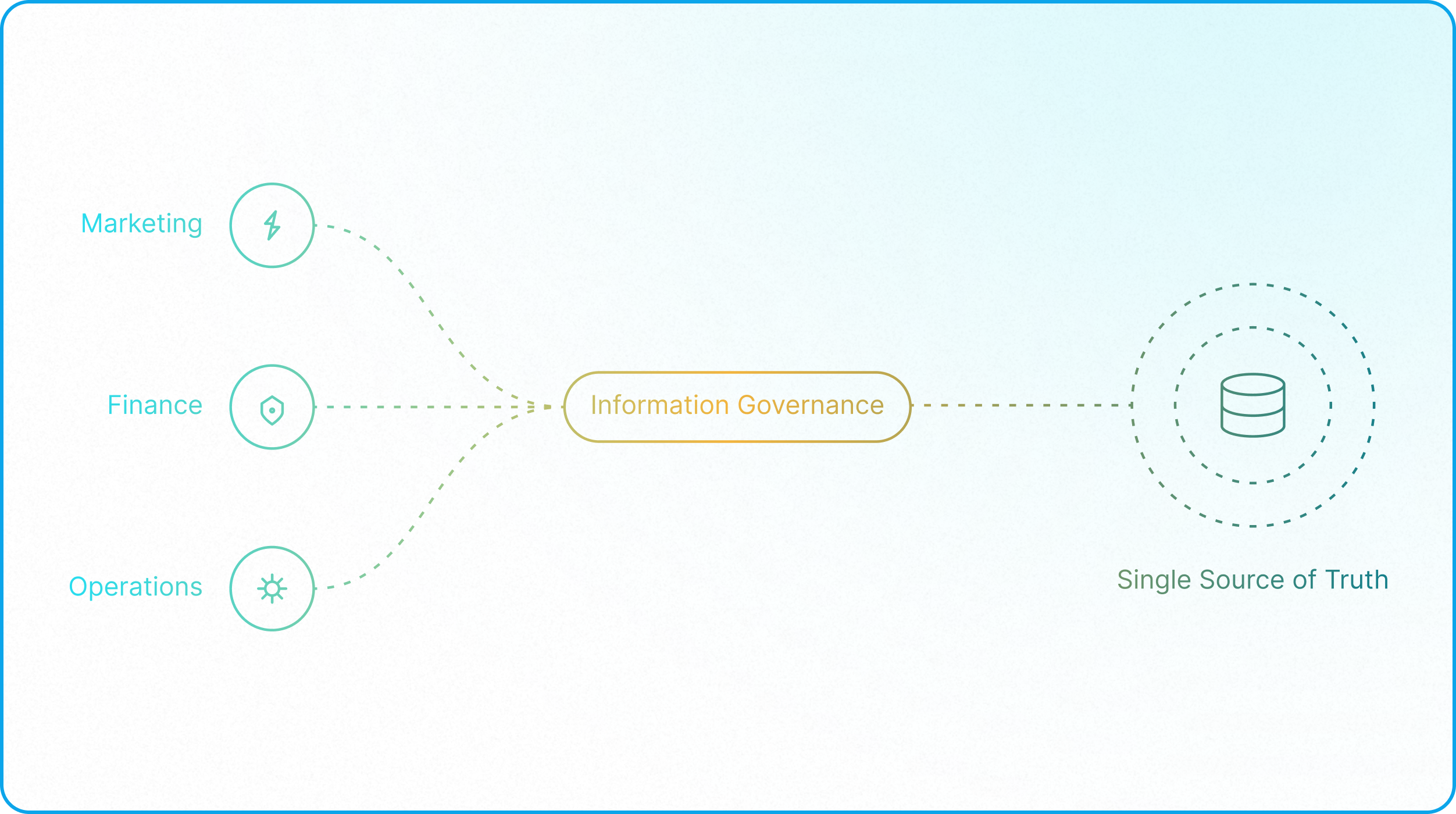
When an enterprise scales, data ceases to be a localized IT concern and rapidly becomes a battleground for executive priorities. As established in Architecting a Single Source of Truth, decentralizing your architecture successfully bypasses strict technical bottlenecks, but it introduces a profound human friction point. Operations, Finance, and Marketing all fundamentally demand access to the same list of Active Clients, Master Inventory, or Core Contracts.
Distributing that foundational information across the ecosystem presents significant enterprise challenges regarding information security, privacy compliance, and data quality. Solving this is not a matter of configuring software; it requires profound change management and leadership alignment.
The Executive Standoff
The core friction of shared data arises from conflicting departmental mandates.
- Marketing is incentivized by velocity and agility; they want raw data accessible instantly to capitalize on market trends.
- Finance is incentivized by risk mitigation and compliance; they demand data be locked down, heavily audited, and restricted to prevent catastrophic PII exposure or MRR leaks.
- Operations are incentivized by stability; they need data to remain static and reliable to ensure supply chains don't break.
When these three departments are forced to share the same core entities, a political standoff ensues. Without strong executive leadership, this tension inevitably results in departmental data hoarding. Leaders, distrusting the integrity of a shared system, will quietly instruct their teams to export data into isolated spreadsheets, destroying organizational visibility and breeding a culture of Shadow IT.
Establishing Information Governance
For an enterprise architect, the most critical work happens before a single line of code is written or an Airtable base is configured. While our Enterprise Airtable Architecture Foundations outlines the strict technical requirements for a Single Source of Truth, that architecture cannot be successfully deployed until the C-Suite first agrees on what that truth actually is.
To overcome these significant enterprise challenges, organizations must establish an Information Governance Committee. This is a mandatory leadership coalition, typically involving the CISO, CFO, and departmental heads, tasked with defining the exact business rules surrounding shared data.
Before cross-departmental data can legally and operationally flow through the Airtable ecosystem, the committee must establish the enterprise framework:
- Strategic Alignment & Risk: How does the distribution of this data align with the organization's overarching risk management matrix, data retention schedules, and legal compliance obligations?
- Policy & Standards: What are the enterprise-wide standards for data taxonomy, and what are the strict protocols for how a new department requests access to shared information?
- Accountability & Stewardship: Who holds ultimate executive accountability for the integrity of core entities, and what are the explicitly defined responsibilities of the localized data stewards?
- Change Management: How will leadership actively champion a culture of rigorous information governance to permanently dismantle the habits of localized, ad-hoc data hoarding?
Moving from "Ownership" to "Stewardship"
A massive hurdle in shared data governance is the territorial nature of departmental leadership. Sales teams often feel they "own" the client data because they acquired it. Finance feels they "own" it because they bill it..
True enterprise governance requires a cultural shift from data ownership to data stewardship. The executive mandate must make it clear: the enterprise owns the data. Departments act as stewards of specific data entities within their operational mandate (the Clients, Invoices, Contracts, or Payments that fall within their domain). They are not owners. They are custodians.
When leaders understand that they do not own the client record (they are merely borrowing the core entity to attach a marketing campaign to it), the territorial friction dissolves. This cultural shift allows for the strict enforcement of security policies and the Principle of Least Privilege without triggering departmental defensiveness.
The Architect as a Business Leader
For professionals transitioning from localized builders into true enterprise architects, this represents a fundamental career pivot. Your value to the organization is no longer measured only by your ability to connect APIs, configure fast syncs, or patch broken automations. Your value is also determined by your ability to facilitate operational peace between conflicting C-suite priorities.
To add immediate, undeniable value to executive leadership, architects must step out of the Airtable database and into the boardroom. This requires mastering three critical leadership competencies:
1. Translating Technical Debt into Business Risk
Executives do not care about schema limits or API payloads. They care about risk mitigation and ROI. An enterprise architect must learn to translate technical reality into executive language. Instead of telling the CFO, "We need to decentralize because the database is too slow," the architect must say, "Our current shared architecture exposes us to severe compliance violations and internal data leak risks. We must govern this data to protect the company."
2. Forcing the Hard Conversations
An order-taking citizen developer asks a department head, "What fields do you want in your base?" An enterprise architect asks, "What is the absolute minimum data you need to hit your KPIs, and what is the business justification for accessing this restricted PII?" Architects must become comfortable with challenging departmental demands. By enforcing security boundaries at the human level (before any software is configured), you act as a critical shield for the enterprise.
3. Transitioning from Order-Taker to Policy-Maker
To be viewed as a business leader, you must proactively architect the playbook. Do not wait for leadership to dictate a data governance policy from scratch; executive bandwidth is often reserved for overarching business strategy. Instead, draft the Information Governance Charter yourself to facilitate their decision-making. Define the stewardship rules. Establish the exact protocols for how a new department requests access to shared data, and present this framework to the committee for approval.
By actively leading the conversations around privacy compliance, data stewardship, and information security, you elevate yourself from a software specialist into an indispensable strategic partner. You are no longer just building workflows and handling Airtable bases; you are forging the corporate policies that protect the enterprise from regulatory disaster. This is how you secure a permanent seat at the executive table.
To see how this governance philosophy dictates your broader structural roadmap, return to the Enterprise Airtable Architecture Foundations
For the technical implementation of these governance rules, review Architecting a Single Source of Truth and Unified Core Schema.