 ·
4 minute read
·
4 minute read
When operations leaders complain about Airtable's performance, they usually point to API throttling, automation timeouts, or record limits. They assume the engine has failed them.
In reality, the software isn't breaking; their architecture is. As we established in, Airtable only becomes a maintenance nightmare when the workspace configuration no longer reflects the structural reality of the enterprise. "Zero-maintenance" is a marketing myth. What you actually design for is zero governance debt.
When internal builders compensate for ambiguous source ownership by deploying cross-base syncs, undocumented middleware, and bloated interfaces, they create massive operational liability. You do not scale a system by building more automations to patch a weak schema. You scale by building a relational foundation so strict that the system natively absorbs the load.
Here is the operational reality of how you engineer it.
1. Schema Discipline Eradicates "Zapier Glue"
The single most expensive operational risk in enterprise Airtable is relying on peer-to-peer middleware to patch unresolved architectural boundaries.
When operations teams build synchronization pipelines simply to keep duplicate records aligned across isolated silos, they introduce what software engineers define as Technical Debt, specifically, "Transitive Dependency Debt" (as detailed in Architecting a Unified Core Schema).
If one of these pipelines fails due to an API timeout or a misconfigured webhook, Make or Zapier will alert you. However, a user accidentally altering the view filter that acts as the automation trigger creates a genuinely silent point of failure. When a trigger view is corrupted, the system breaks in one of two ways:
- The True Silent Failure: The filter becomes too restrictive, so the intended records no longer enter the view. The automation stops running entirely. Make and Zapier log zero errors because they simply assume there is no new data to process. Your downstream systems quietly starve for data, operating on stale data.
- The 'Green Checkmark' Catastrophe: The filter becomes too broad, pulling in unintended records. The automation executes exactly as programmed, logging a perfect trail of green "Success" checkmarks while applying updates to the wrong data. This is the exact architectural flaw that leads to scenarios like sending an 'account cancelled' email to a thousand active customers.
You solve this through structure, not better syncs. You eliminate the fragile automation loops by enforcing strict relational data modeling (see Database Normalization). By forcing the core schema to own the truth, a single state change at the source optically cascades. The maintenance burden drops because there is no mirrored data left to drift.
2. Securing the Write Path via Interfaces
Data corruption rarely originates from software bugs; it originates from ungoverned human behavior. If you give an operator raw grid access to a database, they will eventually overwrite a formula, miscategorize a status, or manually delete a core dependency.
To achieve resilience, you must physically decouple the data from the operator. You enforce this by treating Airtable Interfaces as role-based control surfaces. Day-to-day operators should never see the backend database: they interact exclusively with custom interfaces designed as restricted input paths. However, an interface cannot compensate for a broken schema. If the underlying schema allows an invalid state, the interface becomes a workaround. Your foundation must be a schema strict enough that the interface's role-based controls align with structural constraints, rather than overriding them. When an operator needs to submit a vendor invoice, the interface conditionally removes the "Submit" button until all compliance prerequisites are verified, enforced through both schema validation and interface logic.
3. Automation as a Governed Microservice Layer
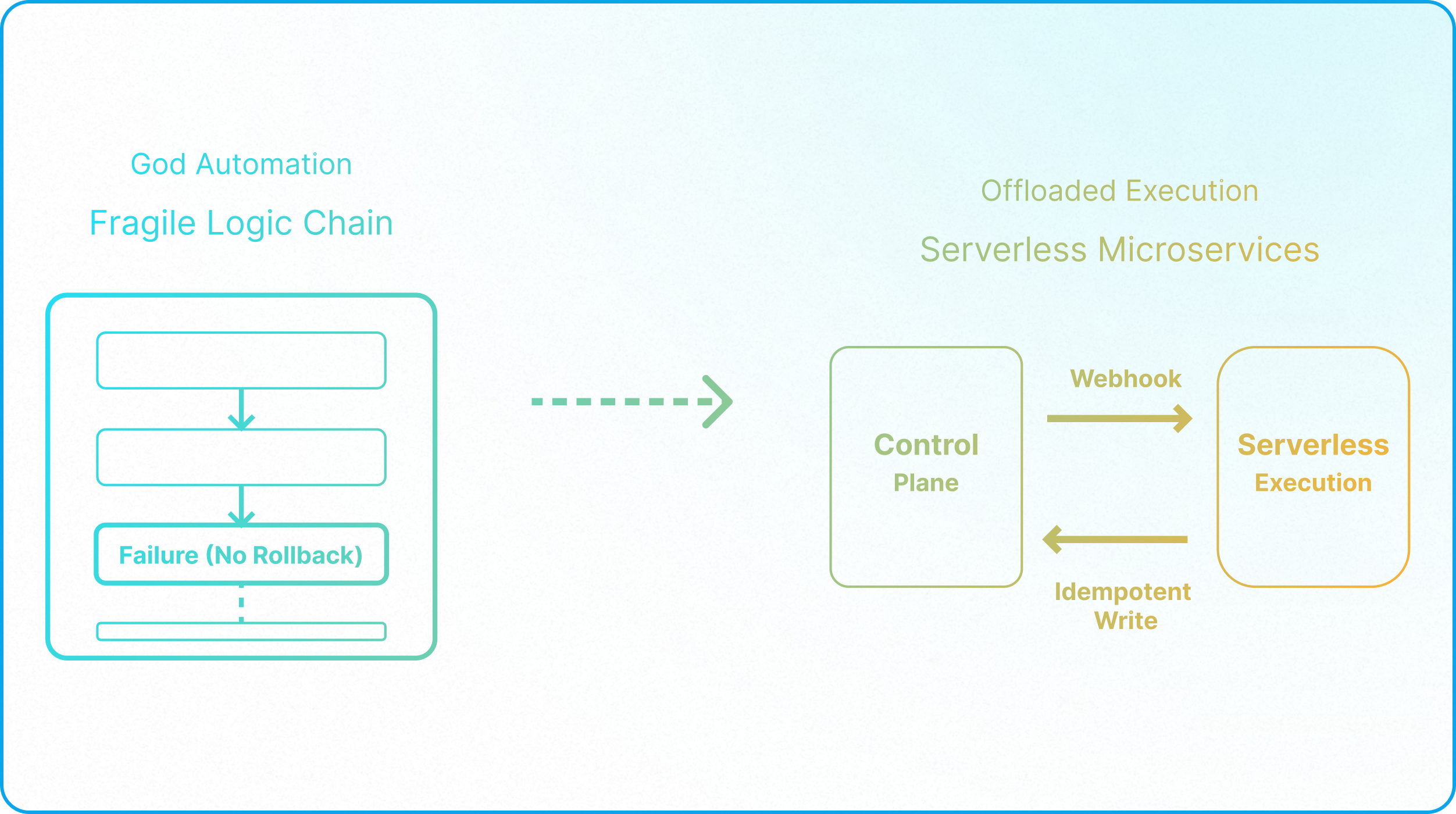
In ungoverned environments, builders deploy automations chronologically. This results in "god automations" that cram an entire operational workflow (validating a payload, updating a status, generating a record, and firing a Slack message) into a single visual block.
Airtable does not have native transactional rollback. If step three in that massive automation fails, steps one and two do not undo themselves. The data is left in an unresolvable, half-processed state, requiring an administrator to manually dig through the run history logs to reconcile the transaction.
Resilient architectures treat automation as a formal, governed microservice layer. You design for the failure state. By transitioning away from visual block builders to Configurable Automation Scripts, you engineer advanced try/catch error logging directly into the control plane. You structurally decouple the logic so that a failed Slack notification does not prevent the core database from officially registering a project's state transition.
4. Offloading the Execution Plane
Finally, you must respect the physical constraints of the platform. Airtable is a highly flexible relational operational layer; it is not a high-velocity computation engine. When you force native automations to run complex financial modeling, massive batch updates, or heavy recursive data transformations, you hit execution limits. The platform throttles.
When your architecture approaches these constraints, you extract the computational drag entirely. You separate your control plane from your execution plane.
To ensure this handoff never corrupts your core database, the integration layer must rely on Idempotent API Design. This is a strict architectural safeguard guaranteeing that if a webhook misfires, times out, or duplicates, the downstream system processes it exactly once. The heavy parsing occurs asynchronously, entirely off-platform, and the final state is safely written back to the Airtable grid.
This offloading strategy guarantees that no matter how complex the enterprise becomes, the core operational environment remains fast, highly governed, and requires near-zero manual intervention.
The Architectural Diagnostic
If you are unsure whether your Airtable environment is operating as a governed system or simply a fragile spreadsheet, run your current setup through this three-point diagnostic:
- The 'Side-Channel Coordination' Test: If a department lead has to send a Slack message to confirm an approval status because they don't trust that the Zapier sync actually fired, your Airtable base is no longer a system of record. It is simply a passive log of decisions being made elsewhere.
- The 'God Automation' Test: Open your Automation Run History. If you see massive visual blocks containing 10+ sequential actions (updating a status, moving a record, firing a webhook) without a single try/catch error-routing script, you are structurally exposed. Airtable lacks native transactional rollback. When step four fails, your record is permanently corrupted in an unresolvable, half-processed state.
- The 'Hidden Logic' Test: If your critical operational dashboards are fed by recursive formula fields that only the original citizen-builder understands, you are running undocumented business logic. When that builder leaves the company, your architecture becomes a legacy black box that the organization is terrified to touch.
When an enterprise stops trusting the execution layer, operators inevitably revert to manual workarounds. You cannot automate your way out of structural decay.
The Execution Mandate
You cannot untangle a fragile automation web while the business is actively running on it.
Your immediate next step is an Automation Freeze: do not allow internal teams to deploy another cross-base sync or third-party webhook until you have established a strict architectural separation between your core database and your execution layer.
If you need a systems engineering partner to safely extract your heavy computation to AWS Lambda, rewrite your failing visual automations into idempotent scripts, and permanently lock down your Airtable schema, that is exactly what Airtable Consultants at InAir do.
Schedule a Discovert Call With InAir.
We will identify your most critical operational failure loops and engineer the resilient infrastructure required to eliminate your governance debt.