
 ·
3 minute read
·
3 minute read
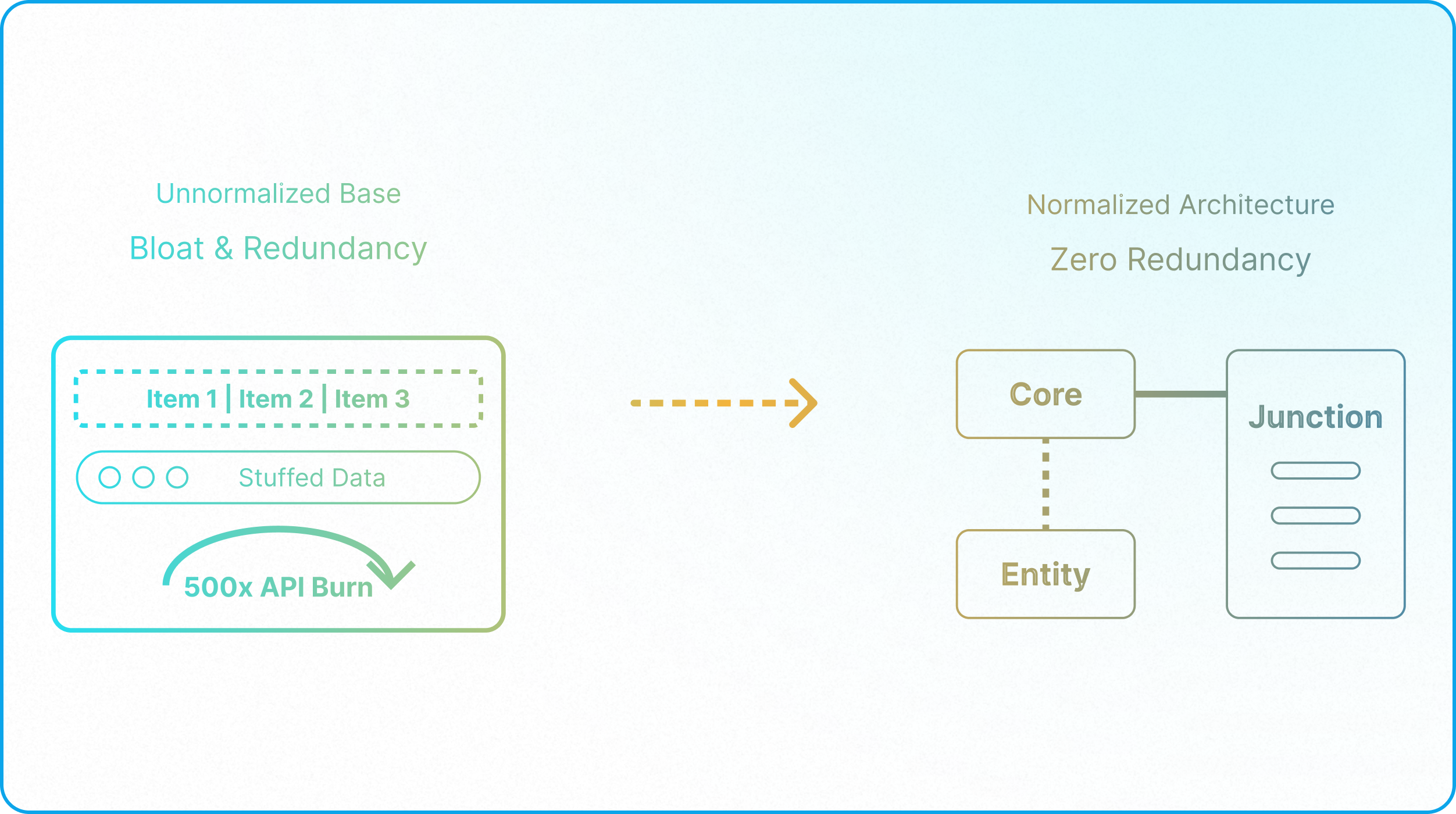
Every citizen developer eventually builds an Airtable base that collapses under its own weight. When the base grinds to a halt, they usually blame the platform. But it’s not because Airtable can’t handle scale: it’s because the schema violates the mathematical laws of relational data.
As we covered in, a poorly built base burns through Airtable's 500,000-record Enterprise limit. But record bloat is only half the problem. An unnormalized database actively destroys your monthly automation execution limits and requires massive webs of fragile, decentralized logic just to keep redundant data accurate.
Database Normalization is the strict architectural practice of structuring a relational database to eradicate data redundancy. To build an enterprise-grade base, an architect must run their tables through the Three Normal Forms. Here is what happens to your Airtable base when you violate it.
First Normal Form (1NF): Eradicating Atomicity Failures
The First Normal Form dictates that every cell in your database must be atomic (containing a single, indivisible value) and that a table must never contain repeating groups.
In Airtable, builders violate 1NF in two ways:
- The Multi-Select Trap: Ops teams frequently use multi-select fields to cram comma-separated data (like "Tags" or "Assigned Teams") into a single cell. Because the cell is not atomic, you cannot run granular automations on an individual tag. If "Design" and "Copy" are in the same cell, an automation cannot fire only when "Copy" is marked complete.
- Horizontal Bloat: Builders routinely create columns named Item 1, Item 2, Item 3. This is a repeating group. When a client orders a fourth item, the operator is forced to manually add an 'Item 4' column. However, existing formulas, automations, and reports are hardcoded to process only the first three items. The system silently drops the new data until someone manually rewrites the underlying logic to include it.
The Architectural Fix: You must strip the repeating groups. You deploy a dedicated "Line Items" junction table. The base scales vertically (which Airtable is designed for), eliminating horizontal bloat and ensuring your formulas never break.
Second Normal Form (2NF): Eliminating Partial Dependencies
The Second Normal Form dictates that every non-key attribute must depend on the entire primary key, not just a part of it. This usually fails when builders attempt to design Junction Tables.
Imagine an "Assignments" junction table that links an Employee to a Project. If you add a column for the Employee's Phone Number in that junction table, you have violated 2NF. The phone number depends entirely on the Employee, not the Project. By placing it in the intersection table, you force the database to duplicate the phone number every single time that employee is assigned to a new project.
The Architectural Fix: The phone number must be stripped from the junction table and placed strictly on the core "Employees" entity. The junction table simply uses an Airtable Lookup Field to optically view the phone number. Zero redundancy.
Third Normal Form (3NF): The Death of the "Sync" Automation
The Third Normal Form dictates that a table must have zero transitive dependencies. In plain English: a field must depend only on the primary key, and nothing else.
Imagine a "Clients" table that includes the Account Manager's Name and the Account Manager's Office Location. The office location depends on the Account Manager, not the Client. If the Account Manager moves to a new office, an unnormalized base forces your ops team to build a massive "Sync" automation: "Find all 500 clients assigned to this Account Manager and update the Office Location field."
This is a catastrophic failure. Updating one employee’s office just burned 500 Airtable automation execution limits in a single second. An unnormalized base bleeds your monthly API quotas dry just to maintain its own redundancy.
The Architectural Fix: Normalization completely eradicates the "Sync" automation. The Account Manager must be broken out into their own dedicated Entity table. The "Clients" table simply links to the Account Manager. If the office location changes, it changes exactly once at the source. Because the "Clients" table is looking through an optical window rather than housing copied text, the location updates across all 500 clients instantly. Zero automations fire. Zero execution limits are burned.
Protecting the System of Record
An unnormalized base is a massive liability. When data is duplicated, it is mathematically impossible to guarantee which table holds the true, current state of the business.
By running your Airtable schema through the Three Normal Forms, you forge an impenetrable vault. You can build infinite workflows, automations, and interfaces on top of it, knowing with absolute certainty that your underlying foundation will never contradict itself, the bedrock every other layer of a larger Enterprise Airtable Architecture is built on.