
 ·
4 minute read
·
4 minute read
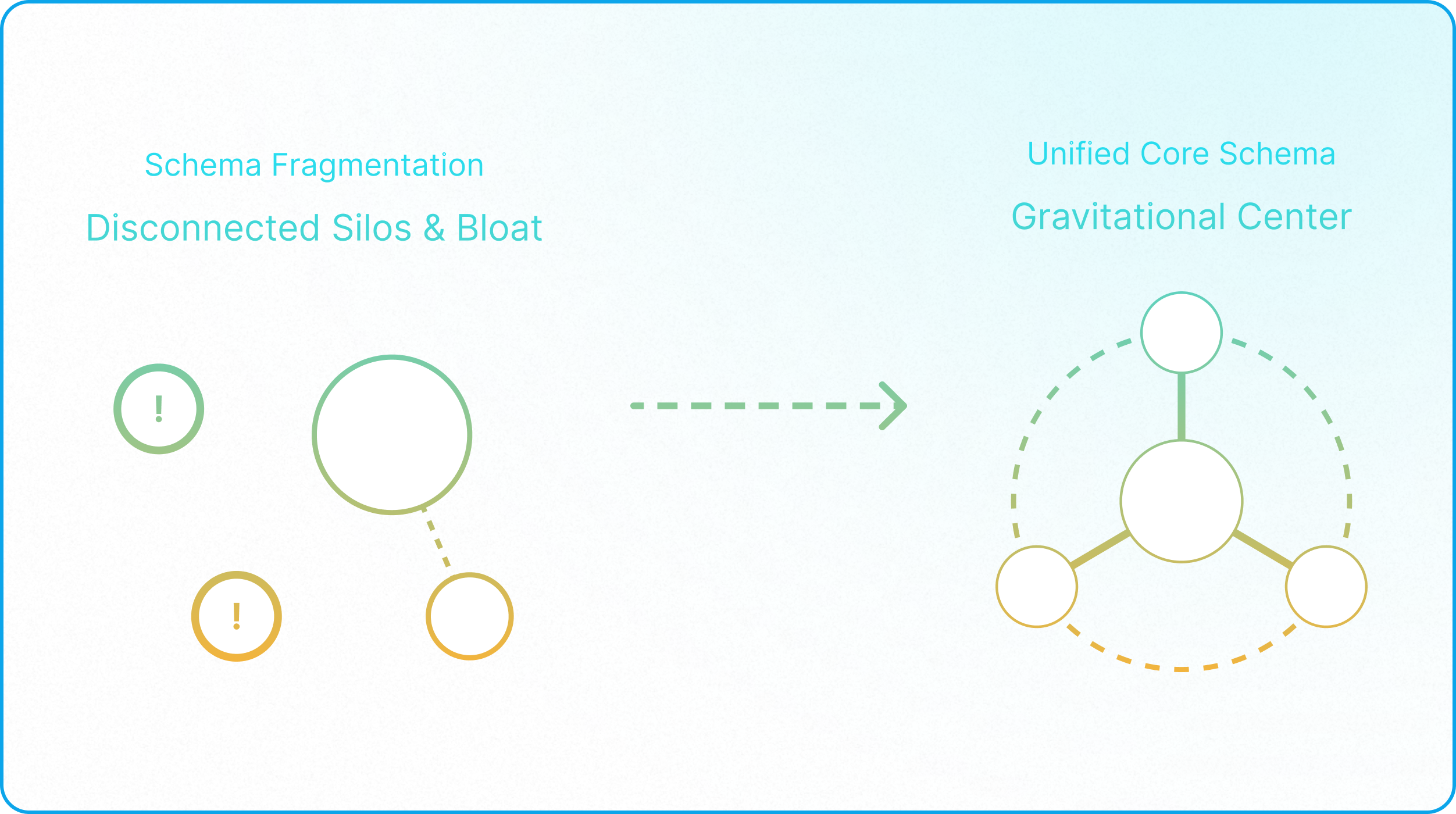
As business units launch reactive, departmental builds, such as a marketing calendar, a bug tracker, or a vendor onboarding pipeline, the organization defaults to a "Connector Mindset." This is the belief that you can simply "connect" disparate silos through syncs and middleware.
This mindset is a structural trap. In an enterprise environment, integrations do not solve fragmentation; they hide it. Airtable builds is not the platform: it is the absence of an intentional data model. To escape that ceiling, the organization must transition from a collection of isolated applications to a Unified Service Layer.
1. The Myth of the "Connector" Solution
In fragmented environments, the default reaction to a data silo is to build a bridge. Whether using Airtable Sync or third-party middleware, these bridges create Transitive Dependency Debt.
Airtable Sync connects bases at the view level. The records visible in the destination are determined by static filters configured on the source view. If those filters change, the set of synced records changes with them.
Critically, dynamic filtering is not inherited from the source base, meaning the destination has no visibility into filtering logic applied upstream. At enterprise scale, this creates a specific governance risk: structural reorganizations or filter modifications at the source require systematic auditing of every downstream sync that depends on them. (Field renames are handled transparently via Airtable's underlying field IDs and do not disrupt automations or syncs; the risk here is limited to custom scripts that reference field names rather than IDs.) When two-way sync is enabled (available on Business and Enterprise plans), editing authority becomes distributed across bases, which introduces coordination overhead that a unified schema eliminates.
When teams bypass Sync and build automation chains to move data between bases manually, the structural cost is explicit: every record update burns automation execution limits to maintain consistency that the schema's own structure should have enforced from the start.
The compounding overhead of cross-base dependencies (whether through sync or automation) is not a tooling problem; It is an architectural one. The architectural principle worth internalizing here is not that syncing is always wrong; it is an acceptable trade-off for stable reference data like Client Names or Account IDs. The problem arises when sync is used as a substitute for intentional schema design, particularly for volatile operational data. When that happens, the connector becomes a liability, not a solution.
2. Implementing Master Data Management (MDM)
To escape the fragmentation death spiral, you must implement Master Data Management (MDM) within the schema. This is the move from departmental silos to a Golden Record Architecture: a single, authoritative version of every critical business entity: Clients, Projects, Products, Providers.
- The Hub as a Service: The core schema exists in a single base that acts as the single source of truth for the organization. It is not owned by any one department. It is the foundation every department builds on top of.
- Decoupled Workflows: Decoupled Workflows: Departmental bases maintain their own operational entities (Invoices, Payments, Orders) while linking to core Hub master entities (Clients, Projects, Products). This mirrors the Data Mesh architecture recommended for decentralized enterprises. By centralizing master data in the Hub while departmental bases own their transactional workflows, even if a departmental "Spoke" base is deleted, the enterprise's foundational reference data remains intact in the Hub.
The architectural mandate for enforcing this boundary is the Separation of Concerns principle: each base has a defined domain and a controlled blast radius. A marketing coordinator cannot break the company's financial ledger. A vendor onboarding pipeline cannot corrupt the master client directory.
3. Schema Gravity and Data Drift
A Unified Core Schema operates like a solar system, requiring a gravitational center, a principle covered in depth in Enterprise Airtable Architecture. Core entity tables, such as "Master Clients" and "Master Projects", act as the sun. Every other workflow must orbit that center via a structural link.
The alternative is Data Drift. When the same client exists in five departmental trackers, updated at different times by different operators, you don't have a system; you have five competing versions of the truth. Anchoring all data to a unified core guarantees that when a record changes at the source, the truth cascades everywhere instantly. No sync chain required. No execution limits burned.
This is precisely why Database Normalization alone is insufficient without a Hub-and-Spoke governance model above it. Normalization prevents redundancy inside a base. The Unified Core Schema prevents redundancy across the entire enterprise.
The Service Layer Diagnostic
If an environment is struggling to scale, it is failing one of these architectural mandates:
1. The Subscription Test:
- Are your data boundaries clearly defined? A healthy architecture dictates that each departmental base owns its functional data and strictly subscribes to universal records (such as Clients or Projects) governed by the central Hub.
- If data boundaries are not clearly defined, you don't have a database; you have a fragile, chaotic spiderweb.
2. The Dependency Test:
- Can you name which fields and filters on your central hub are being referenced by which team(s) in one or more downstream bases?
- If you cannot answer that question, your cross-base dependencies are ungoverned.
3. The Golden Record Test
- Can you point to a single, unambiguous record for every client, project, or product in your system, one that every team reads from and no team can independently overwrite?
- If not, the data integrity of the entire operation is at risk.
The Directive
The path from fragmented silos to a Unified Service Layer is an architectural decision, not a cleanup project:
- Freeze new base creation.
- Audit every departmental tracker against the three tests above.
- Identify which tables are rogue satellites and which are legitimate extensions of the core schema.
There is a distinct line between building a tracker and governing a system. Internal teams can build, but may not have the capacity to re-architect a live environment without breaking it. When the schema is shattered across twenty departmental bases, all connected by fragile sync dependencies and manual automation chains, untangling it without disrupting operations requires a different kind of expertise.
That is precisely what InAir does. We specialize in collapsing fragmented environments into governed, high-capacity Enterprise Airtable Architectures, establishing the Golden Record, enforcing Hub-and-Spoke governance, and locking the schema so operational teams can build on top of it with confidence.